
Bio’loo: the enzymatic toilet revolutionizing hygiene in underground environments
On an underground construction site, in a mine or tunnel, every square metre counts, and every piece of equipment must meet extreme requirements: confined spaces, the absence of a sewage network, and stringent safety standards. It is in this context that Sub’roca, a French specialist in safety equipment for underground works, developed Bio’loo, a unique, self-contained industrial sanitation system.
Designed to operate for several months without emptying or maintenance, Bio’loo addresses a concrete and too often overlooked need: providing teams working underground with access to clean, safe and environmentally friendly toilets.
What is Bio’loo?
Bio’loo is a self-contained industrial sanitation system using enzymatic treatment, specifically designed for underground mines, tunnel boring machine (TBM) projects and confined construction sites. Developed by Sub’roca, it incorporates a compact biological treatment unit that turns each toilet into an independent sanitation facility, with no connection to sewage networks.
In practice, wastewater is transferred directly into a completely sealed treatment tank, ensuring a controlled and secure process even in the most confined environments. The enzymatic solution used, known as Sub’zyme, is biodegradable and non-toxic. It breaks down organic matter with every use, without the need to handle aggressive or hazardous chemicals.
No aggressive chemicals and no hazardous handling: treatment relies solely on the biodegradable Sub’zyme enzymatic solution.
How does Bio’loo’s enzymatic technology work?
The principle is based on a compact biological treatment unit installed directly beneath the toilet cabin:
This short-loop treatment process enables Bio’loo to remain operational where installing a conventional sewage network would be impossible or too costly.
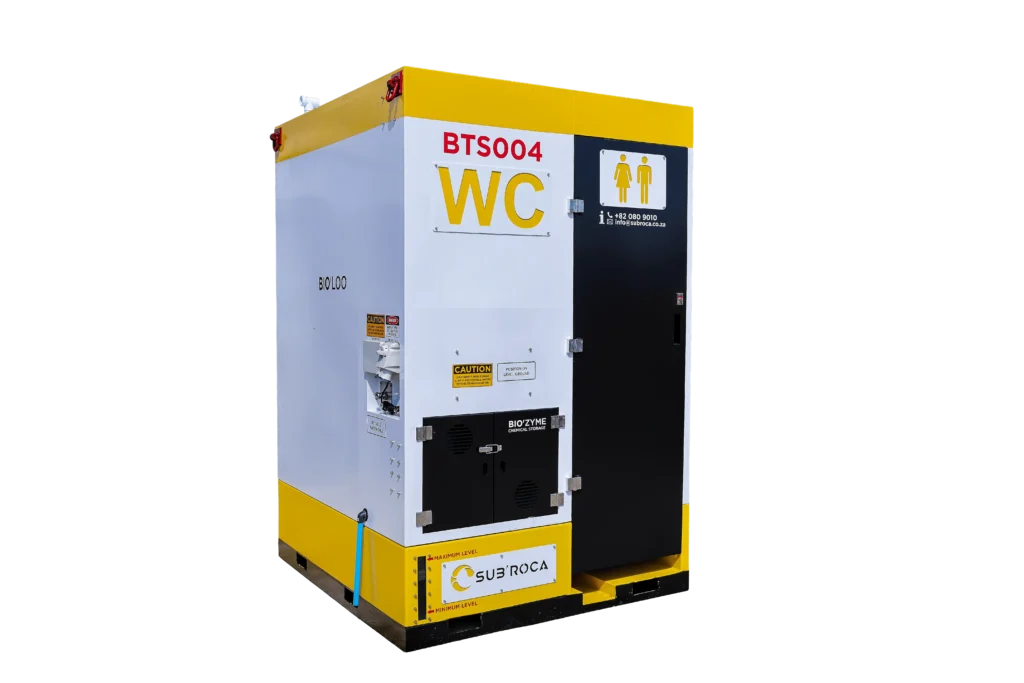
The benefits of Bio’loo for underground works
One emptying per year instead of several times a month: Bio’loo drastically reduces maintenance requirements while improving hygiene for teams working on site.
What environments is Bio’loo designed for?
Bio’loo was designed for environments where installing conventional sanitation facilities is difficult or even impossible:
Bio’loo vs. conventional chemical toilets: what’s the difference?
|
Criteria |
Bio’loo (enzymatic) |
Conventional chemical toilet |
|---|---|---|
|
Emptying frequency |
Up to 12 months and more |
Several times a month |
|
Products used |
Biodegradable, non-toxic solution |
Aggressive chemicals |
|
Odours |
Significantly reduced |
Often pronounced |
|
Environmental impact |
Low |
Higher |
|
Suitable for confined underground environments |
Yes, specifically designed for this purpose |
Possible, but not optimized |
Frequently Asked Questions
Thanks to the efficiency of its continuous enzymatic treatment, Bio’loo can operate for up to 12 months without emptying, compared with much more frequent servicing for traditional chemical toilets.
Bio’loo uses Sub’zyme, a biodegradable and non-toxic enzymatic solution that breaks down organic matter without the use of hazardous chemicals.
Yes. Bio’loo is available in a Dual version (separate male and female facilities) or a unisex version, allowing it to adapt to a wide range of professional environments.
Made in France, Bio’loo is part of Sub’roca’s range of safety and comfort equipment, alongside refuge chambers and ventilation systems for underground works. Sub’roca supports its customers with equipment training, international delivery and dedicated after-sales service.
Table of contents
Related product
Bio'Loo: Underground Enzymatic Sanitation
https://subroca.com/underground-safety-equipment/bioloo-underground-enzymatic-sanitation/