Why purify the air in an emergency shelter?
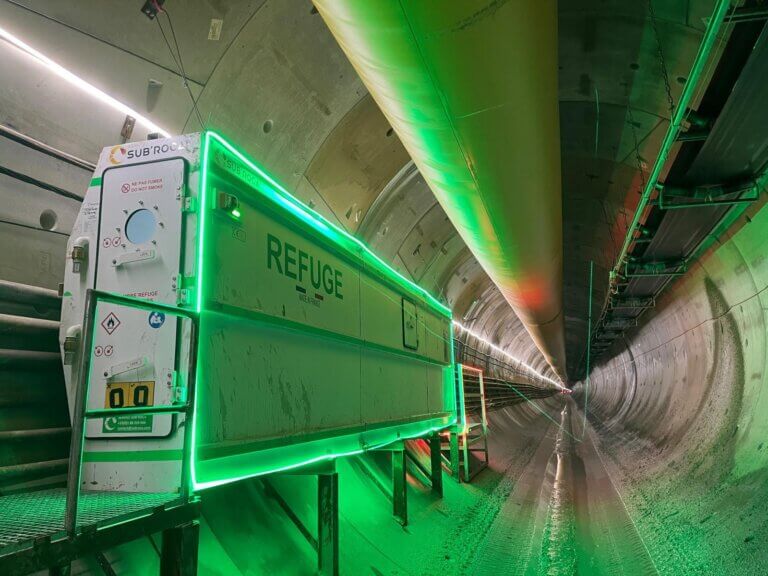
The fire that broke out at the High Speed 2 tunnel construction site in London has, once again, demonstrated the critical importance of having operational emergency shelters in underground sites. A look back at the incident and the lessons learned.
The air inside an emergency shelter may be contaminated by human activity, such as breathing, or external pollution (improper use of the airlock). The danger posed by such contamination in an enclosed space is the increase in concentrations of carbon monoxide (CO) and carbon dioxide (CO₂), which can reach lethal levels.
For a refuge without a fresh air supply, it is therefore recommended to use a scrubber: a machine designed to purify gases. This scrubber typically uses interchangeable filter cartridges.
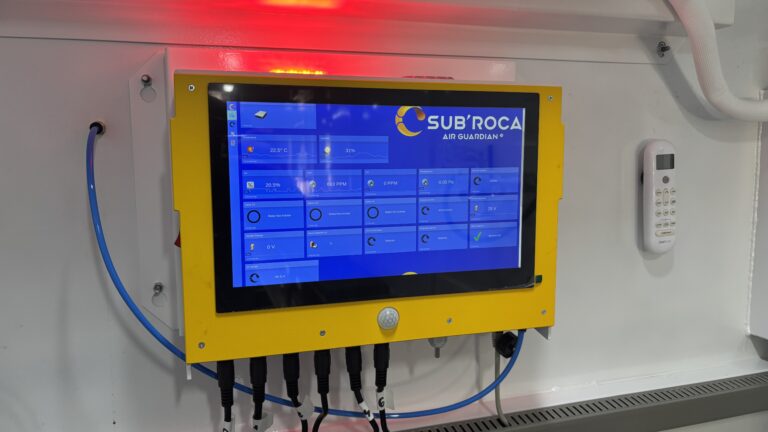
Sub’roca offers a turnkey solution to ensure real-time safety of the refuge’s atmosphere using the Airguardian. This multi-gas monitor is designed to be simple and intuitive to use. It monitors the air quality of your underground work environment at all times and in all locations.
Carbon Dioxide – CO2
Carbon dioxide, an odorless and colorless gas, is present in the atmosphere at a concentration of 413 ppmv (parts per million by volume), or 0.0413%. CO2 is emitted through the respiration of living organisms and the combustion of fossil fuels such as oil, coal, or natural gas.
The severity of CO2 poisoning varies depending on the concentration and duration of exposure.
A concentration of 5,000 ppm—equivalent to 0.5%, for regular exposure over an eight-hour workday is generally used as a benchmark by various organizations.
- The 8-hour time-weighted average for the European Union (Directive 91/322/EC);
- The TLV-TWA (time-weighted average) an 8-hour daily and 40-hour weekly average established by the ACGIH (American Conference of Governmental Industrial Hygienists) in the United States;
- The MAK (Maximale Arbeitsplatz Konzentration) value, an 8-hour time-weighted average limit, in Germany;
- The OES (Occupational Exposure Standard) in the United Kingdom.
Occupational Exposure Limits for Carbon Dioxide (CO₂)
|
Over 8 hours |
Instantaneous Peak |
IDLH(*) |
|
|
European Union |
5 000 ppm |
– |
– |
|
Germany |
5 000 ppm |
10 00ppm |
– |
|
United Kingdom |
5 000 ppm |
15 000 ppm – 10 min |
– |
|
United States |
5 000 ppm |
30 000 ppm |
40 000 ppm |
Monoxyde de Carbone – CO
Carbon monoxide is a colorless, odorless, and toxic gas. It results from the incomplete combustion of any type of fuel: wood, coal, petroleum, natural gas, etc. Another source of carbon monoxide is human respiration. A smoker exhales air containing up to 50 ppm.
|
0 – 3 ppm |
This applies to a person who has not smoked, at least not in the last 24 hours. |
|
3 – 10 ppm |
These levels are reached in the following cases: |
|
10 – 20 ppm |
Light smoker; these levels correspond to occasional smokers, or when the last cigarette was smoked several hours ago. |
|
21 – 50 ppm |
Heavy to very heavy smoker. |
|
sup. à 50 ppm |
Levels above 50 ppm are rarely recorded; they are observed in very heavy smokers, those who inhale cigar or pipe smoke, or those who smoke cannabis. |
CO prevents oxygen from reaching the body by binding to red blood cells. This causes symptoms such as headaches, dizziness, nausea, vomiting, and mental confusion.
Occupational exposure limits for CO vary internationally. The 8-hour occupational exposure limit (OEL) for CO generally ranges from 20 to 50 ppm.
Occupational Exposure Limits for Carbon Monoxide (CO)
|
8-hour average |
Short-term peak |
|
|
European Union |
20 ppm |
100 ppm |
|
Germany |
60 ppm |
30 ppm |
|
United Kingdom |
30 ppm |
200 ppm |
|
United States (OSHA) |
VLEP-8h : 50 ppm 8h-TWA : 25 ppm |
– |
|
United States (NIOSH) |
35 ppm |
200 ppm |
SUB’ROCA’s Solution: the Scrub’Tech Scrubber
Carbon Dioxide (CO2) Treatment
The chemical compound in the filter cartridges produces an exothermic reaction at room temperature when it comes into contact with CO2, according to the following chemical equation:
CO₂ gas + Ca(OH)₂ solid → CaCO₃ solid + H₂O liquid
Carbon Monoxide (CO) Treatment
The chemical compound in the filter cartridges produces an exothermic reaction at room temperature when it comes into contact with CO, according to the following chemical equation:
2CO gas + O₂ gas → 2CO₂ gas
Air Purification
Sub’roca’s air purifier features a purification process that is unique in the world. It eliminates odors, all biological pollutants (viruses, bacteria, mold), fine particles from combustion, as well as chemical pollutants (VOCs, formaldehyde, NOx).
Scrub’Tech Operating Time
The Scrub’Tech’s operating time was determined by Sub’roca’s research department through modeling of pollutant concentrations in the air inside the shelter.
The graphs below show changes in air quality (CO and CO₂ concentrations) over a 6-hour period in a shelter housing 24 people.
Under these conditions, the shelter’s 24-hour autonomy is ensured by 1 CO filter cartridge and 5 CO₂ filter cartridges.
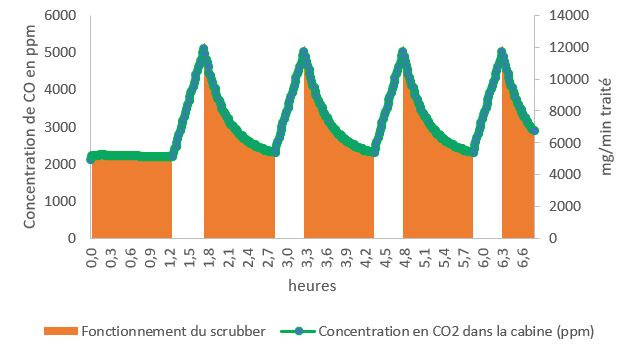
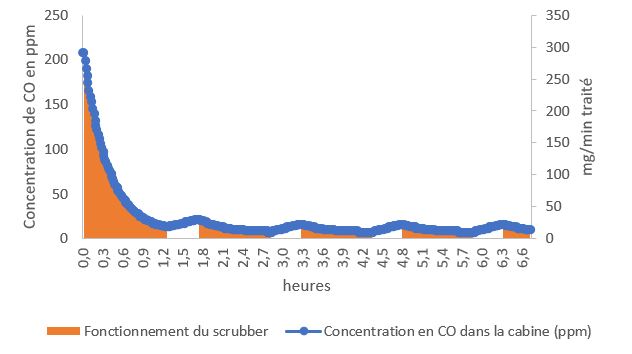
Table of contents
related product
Shelt'air emergency refuge chambers
https://subroca.com/underground-safety-equipment/sheltair-emergency-refuge-chambers/